 Last week on the freeware review, I wrote about the simplicity of packet sniffing and analyzing with Ethereal. I revealed how easy it was for anyone to tap sensitive data like login information, credit card numbers, social security number, and mission-critical emails traveling on the network. As promised, I will reveal how to actually prevent packet-sniffing software from reading your sensitive data.
As I previously explained, packet analysis passively listens into a network and then extracts the important data, which is usually in plaintext. The key to hampering packet analysis is encrypting that data sent on the network so that it is not read in plain text. The encrypted data that packet analyzers gather is pretty useless without an encryption key. While it is possible for crackers to obtain the key, encryption makes the process a lot longer (and sometimes nearly impossible). There are a couple common ways to do this.
Read the rest of this entry »
In this never-ending quest for quality freeware to introduce to the freeware review, my dad asked me to find him something that did one specific thing. He needed a program that would compare the differences between two documents.
Take, for example, transcription. If you want to ensure the accuracy of a transcript, you can have two people transcribe the recording of a speech or interview to separate documents. Then, you run a program to compare the two. Maybe one transcriber heard “He hurt the baby” instead of “He burped the baby.” One word can make a world of difference!
Another example of using a comparison program is when you email your friend a document so that he or she can proofread it. Your friend edits the document and emails it back to you. Instead of going through the entire document line-by-line to see changes, you can just run the comparison program to point you to the changes.
Read the rest of this entry »
 When I was in high school, I used to be involved in the desktop publishing department. Essentially, I was a yearbook geek. In most places, you receive your yearbook towards the last month of school. I’ve even heard of some schools distributing yearbooks from the previous year in August! In addition to the regular yearbook, our academy released a “pre-yearbook” in the first month of school so we can get used to all the (few) new faces. I’ve also attended other institutions with a similar publication. They called it “The Dating Catalog” or “The Mugshots.” We called ours the “JCA Buddy List.” That year, we designed the pages in sharp color as opposed to the previous year’s blurry black-and-white.
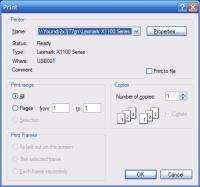
When the cutting-edge design was complete, I went into production. It took forever to print my “Buddy List!” “Forever” comprised of a whole 15 minutes. I checked the “Print Status” window and discovered the problem. Each side of the page I sent to the printer was at least 50 MB large! It wasn’t actually the printing that took long but the sending of the data. We used a high-grade laser printer. Printing one page took approximately 5 seconds. But sending the data via USB 1.0 cable – which is capable of “fantastic” burst speeds of 12 Mbps – took at least 1 minute!
Read the rest of this entry »

